


You need a prescription for acne. Or maybe it's a cold. Nothing serious—just annoying enough that you want help now, not two weeks from now when your doctor has an opening.
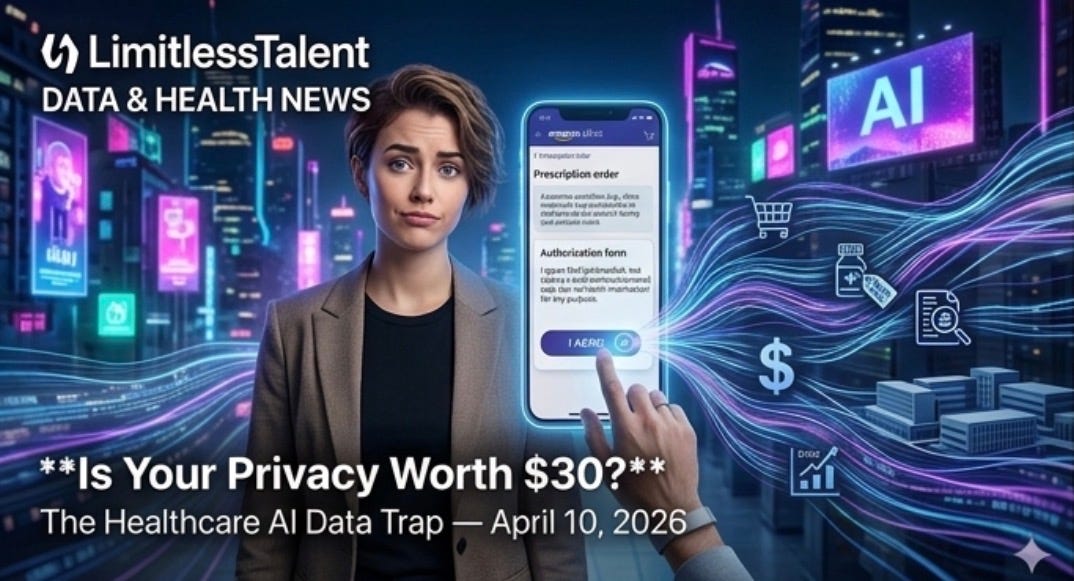
Amazon Clinic offers virtual care for $30. Cheaper than going direct to a clinic partner (which would cost $100+). Quick, convenient, on your phone. You click through a few screens, describe your symptoms, and then… there it is. The authorization form.
"I agree that Amazon.com Services LLC and its affiliates may use my health information for any purpose."
You scroll past it. Everyone does. You click "I agree" because that's what you have to do to become a customer. The thing you probably didn't notice? You just signed away the HIPAA privacy protections you thought you had.
Amazon and Microsoft are racing to embed AI into every corner of healthcare—from virtual care to clinical documentation to patient engagement tools. The pitch is compelling: reduce costs, alleviate physician burnout, improve outcomes. The healthcare AI market is exploding, projected to grow from $21.66 billion in 2025 to over $110 billion by 2030.
But here's what most people don't realize: when you use these "free" or low-cost tools, you're not the customer. Your data is the product.
And the trade-off—signing away your privacy rights without understanding what you're agreeing to—isn't just buried in the fine print. It's becoming the standard operating procedure for how tech companies are entering healthcare.
What Amazon and Microsoft Are Offering (And Why It Sounds So Good)
Amazon Clinic pitches affordable virtual care. Upload your symptoms, connect with a licensed provider, get a prescription. Simple. Fast. Cheap.
AWS HealthScribe promises to reduce physician burnout by using generative AI to transcribe patient-doctor conversations and auto-generate clinical notes. Thousands of hospitals are already using it—TeleTracking, Tel Aviv Sourasky Medical Center, DeepScribe, Solventum. The idea is that doctors spend less time on paperwork and more time with patients.
Microsoft Cloud for Healthcare offers FHIR and DICOM standards for storing protected health information (PHI) in the cloud, plus AI-powered "de-identification" tools that strip identifying details from clinical notes so data can be shared "safely."
On the surface, this all sounds like progress. Healthcare is expensive, doctors are overwhelmed, and patients want faster access. AI could fix these problems.
But there's a catch.
The Fine Print: What Patients Don't Realize They're Signing
When you use Amazon Clinic, that authorization form isn't a routine medical consent. It's a legal document that gives Amazon the right to use your health data "for any purpose" across its affiliates—retail, pharmacy, advertising, AI training, risk profiling. You name it.
Here's the problem: HIPAA (the Health Insurance Portability and Accountability Act) prohibits healthcare providers from conditioning care on signing away your privacy rights. But Amazon's workaround is elegant: We're not the doctor—we're just a marketplace.
Geoffrey Fowler, the Washington Post tech columnist who investigated Amazon Clinic, put it this way on NPR:
"Amazon is essentially grabbing the right to take your data and give it to itself and then do we don't know exactly what with… Amazon has a giant retail business. It now has a pharmacy business. It has a really big advertising business that we don't talk a lot about. Amazon also has other kinds of health care businesses it wants to get into. It's increasingly getting into artificial intelligence. It could take our data and analyze it and try to predict risk scores about different kinds of people."
In August 2023, Rep. Jan Schakowsky and colleagues sent a letter to Amazon CEO Andy Jassy calling this out:
"By requiring consumers to agree that their health treatment data can be used and disclosed by Amazon.com Services LLC and its affiliates for any purpose… individuals must forfeit the federal data privacy protections granted to them under HIPAA."
Amazon's response? Silence.
Why This Is Legal (And Why That's Terrifying)
HIPAA only covers "covered entities"—healthcare providers, health plans, healthcare clearinghouses—and their "business associates." If you're a tech company operating as a "marketplace" or offering a consumer health app that doesn't fit those narrow definitions, you're outside HIPAA's protections.
Most health apps aren't covered by HIPAA. Fitness trackers, wellness apps, symptom checkers—unless they're directly contracted with a hospital or insurance company, they operate in a regulatory gray zone.
Even when companies are HIPAA-compliant (like AWS HealthScribe when used by hospitals), that only applies to specific contractual relationships. It doesn't stop the company from using aggregated, "de-identified" data for other purposes.
And here's the kicker: de-identified data isn't anonymous.
Stanford's Human-Centered AI Institute put it bluntly:
"After health data is de-identified, the question remains: Is patient privacy actually protected? In truth… it is never possible to guarantee that de-identified data can't or won't be re-identified. That's because de-identification is not anonymization."
AI has made re-identification dramatically easier. By cross-referencing multiple datasets—purchase history, location data, search queries—AI can piece together identities even when names and birthdates have been stripped out.
Dr. Niam Yaraghi at Brookings Institution explained the risk, noting that AI is a set of statistical methods designed to uncover patterns in data. He warns that "This could create a major threat to re-identification of anonymized data, especially when such data are merged with other sources of data across multiple platforms."
So when Microsoft or Amazon says they "de-identify" your data to protect your privacy, what they're really saying is: We've made it harder—but not impossible—to connect your health records to your name. And we're still using that data.
What Could Go Wrong?
Let's play this out.
Insurance discrimination. Your de-identified health data gets re-identified and sold to insurers. They use AI to predict your risk profile—based not just on what you've told your doctor, but on what you've bought, where you've been, what you've searched for. Your premiums go up. Or you get denied coverage entirely.
Employment discrimination. Your employer uses wellness app data to assess productivity risk. You mentioned anxiety to a chatbot. The algorithm flags you as a liability. You don't get the promotion.
Targeted advertising. Pharmaceutical companies buy access to your health profile and bombard you with ads for medications you may or may not need. Predatory marketing to vulnerable populations—addiction recovery, chronic illness, mental health struggles.
Erosion of trust. Patients start to realize that what they tell their doctor might end up in a corporate database. So they withhold information. They skip preventive care. They don't mention the symptom that could have been caught early. Health outcomes get worse.
A 2022 AMA survey found that patients are most comfortable with physicians and hospitals having their health data—and least comfortable with social media sites, employers, and technology companies having the same data.
For You: 4 Things to Check Before You Click "I Agree"
If you're using (or thinking about using) AI-powered healthcare tools, here's what you need to know:
1. Read the authorization form. I know, I know—nobody reads these. But if it's asking you to waive HIPAA rights, that's a red flag. Look for language like "use your data for any purpose" or "share with affiliates." If you see that, ask yourself: Do I trust this company with my diagnosis, my medications, my family history?
2. Ask about data deletion. Most HIPAA-covered providers will let you request deletion of your records. Most consumer apps won't. Before you sign up, ask: Can I delete my data later? Will it be removed from AI training sets, or just "de-identified"?
3. Recognize the HIPAA gap. Just because something is marketed as "healthcare" doesn't mean it's covered by HIPAA. If it's an app, a wearable, a symptom checker—chances are, it's not. That means you have fewer rights, less control, and more exposure.
4. Use your state privacy laws. Some states (California, Virginia, Colorado, others) have privacy laws that give you the right to know what data is collected, request deletion, and opt out of data sales. These rights apply even if HIPAA doesn't. Learn what your state allows—and use it.
For Companies and Providers: What You're Risking
If you're a healthcare provider adopting Amazon, Microsoft, or Google AI tools, you need to understand what you're signing your patients up for.
1. Liability. If Amazon or Microsoft has a data breach, your patients won't blame the vendor, they'll blame you. You're the one they trusted with their health information. The fact that you handed it to a third party won't matter to them.
2. Trust erosion. If your patients find out their conversations are being processed by AWS HealthScribe and potentially used to train AI models, some will stop talking to you. They'll withhold symptoms. They'll avoid follow-ups. Your clinical outcomes will suffer.
3. Vendor lock-in. Once you've integrated your entire EHR with AWS or Azure, migrating away is expensive, risky, and time-consuming. You've handed control of your patients' data—and your operations—to a platform that has its own business interests.
4. Regulatory risk. HIPAA is being updated in 2026 to require multi-factor authentication, network segmentation, and faster breach reporting. But the law still doesn't cover consumer health apps or tech platforms operating outside traditional healthcare. That regulatory gap means you could be liable for data practices you don't control.
Before you sign that contract, ask:
What data does the vendor collect? How long is it retained?
Can we request full deletion (not just de-identification)?
What happens if the vendor is acquired, goes public, or changes its data policies?
Are we liable if the vendor has a breach? What does our insurance cover?
How do we explain this to patients in a way that doesn't destroy trust?
Sources and Additional Info
If you want to go deeper on this, here are a few sources worth your time:
"Amazon Clinic patients must sign away some HIPAA privacy rights" (Washington Post, Geoffrey Fowler, May 2023) — The original investigation that exposed Amazon's authorization loophole. Link
"De-Identifying Medical Patient Data Doesn't Protect Our Privacy" (Stanford HAI) — Explains why "de-identified" data isn't anonymous, and why re-identification is easier than ever with AI. Link
"Increasingly, HIPAA Can't Stop AI from De-Anonymizing Patient Data" (Unite.AI, February 2026) — Technical deep-dive on how AI can reverse anonymization by cross-referencing datasets. Link
"Algorithms Are Making Decisions About Health Care, Which May Only Worsen Medical Racism" (ACLU, September 2025) — How AI bias in healthcare disproportionately harms Black, Indigenous, and Latinx patients. Link
Congressional Letter to Amazon CEO Andy Jassy (Rep. Jan Schakowsky, August 2023) — Lawmakers calling out Amazon Clinic's HIPAA workaround. Link
The Takeaway: "Free" Isn't Free When Data Is the Currency
Healthcare AI has enormous potential to reduce costs, alleviate burnout, and improve outcomes. I'm not anti-AI. I'm pro-informed consent.
The problem isn't that Amazon and Microsoft are offering these tools. The problem is that most people don't understand the trade they're making—privacy for convenience, control for access—until it's too late.
HIPAA was written in 1996, before smartphones, before cloud platforms, before AI. It doesn't cover most of the apps and tools we use today. Tech companies have figured that out, and they're exploiting the gap.
So before you click "I agree," ask yourself:
Do I know what I'm agreeing to?
Do I trust this company with my most intimate information?
What happens if this data is breached, re-identified, or sold?
And if you're a healthcare provider: before you hand over your patients' data to a platform that has its own business interests, ask yourself:
What am I risking?
How do I explain this to my patients?
What happens when trust breaks?
Because once trust is broken, it's almost impossible to rebuild.
And in healthcare, trust isn't just nice to have. It's the foundation of the entire system.