



Four major companies just placed a $2.5 billion bet on their people.
Walmart. JPMorgan Chase. Amazon. AT&T. Together, they’re training more than two million workers to thrive alongside AI — not get replaced by it.
This isn’t a press release. It’s a proof of concept. These aren’t experiments or pilot programs. These are billion-dollar commitments backed by retention data, career mobility outcomes, and a simple belief: the people who know your business are worth more trained than replaced.
And here’s what matters most — it’s working.
The Numbers Tell a Story
Walmart is training all 1.6 million U.S. and Canadian workers — frontline and corporate — through a partnership with Google’s AI Professional Certification program. Eight hours of fundamentals for everyone. Advanced modules for those who want to go deeper.
Donna Morris, Walmart’s Chief People Officer, put it plainly: “It’s unfortunate when companies use AI to replace workers instead of training them for what’s ahead.”
CEO John Furner predicts the company will have roughly the same headcount in three to five years — but with workers earning more, staying longer, and moving into leadership roles that didn’t exist before. Top regional managers already earn $420K-$620K. That’s the career arc they’re building toward.
JPMorgan Chase is investing $300 million a year to train 300,000 employees. Not one-size-fits-all training — segmented, role-specific programs. “AI Made Easy” for beginners. Prompt engineering for analysts. Agentic AI for software engineers. Strategic transformation for leaders.
Derek Waldron, their Chief Analytics Officer, describes their approach: “Training needs are varied, just like AI applications. The best way to approach this is segment by segment.”
They’re not just teaching tools. They’re building culture. Town halls. Manager communications. Peer-to-peer learning networks. “Prompt of the week” emails. Social channels where power users share what’s working.
Amazon committed $1.2 billion to upskill 100,000 U.S. workers for higher-skilled roles — both inside and outside Amazon. Their apprenticeship and on-the-job training programs show 94% retention rates. People stay when you invest in their future.
“It’s unfortunate when companies use AI to replace workers instead of training them for what’s ahead.” - Donna Morris, Chief People Officer, Walmart
AT&T spent $1 billion over five years to reskill 180,000 employees when they realized half their workforce lacked the hard skills for the company’s digital future. Instead of expensive outside recruitment, they invested in the people who already understood the business.
The case study is now taught at Harvard Business School.
Why This Works
This isn’t charity. It’s strategy.
Training workers costs less than replacing them. A lot less. Retention saves recruitment expenses. Career mobility reduces turnover. Workers who see a future at your company don’t spend their lunch breaks updating their LinkedIn.
But there’s a deeper truth here: the people who know your customers, your operations, and your edge cases are irreplaceable. You can hire an AI specialist. You can’t hire someone who’s spent five years learning the thousand unwritten rules that make your business actually work.
When you train existing workers, you get AI fluency plus institutional knowledge. That combination — domain expertise meets new capability — is what creates real value.
This isn’t just good for workers. It’s smart business.
The Four Pathways Forward
Not everyone needs to become an AI engineer.
That’s the point.
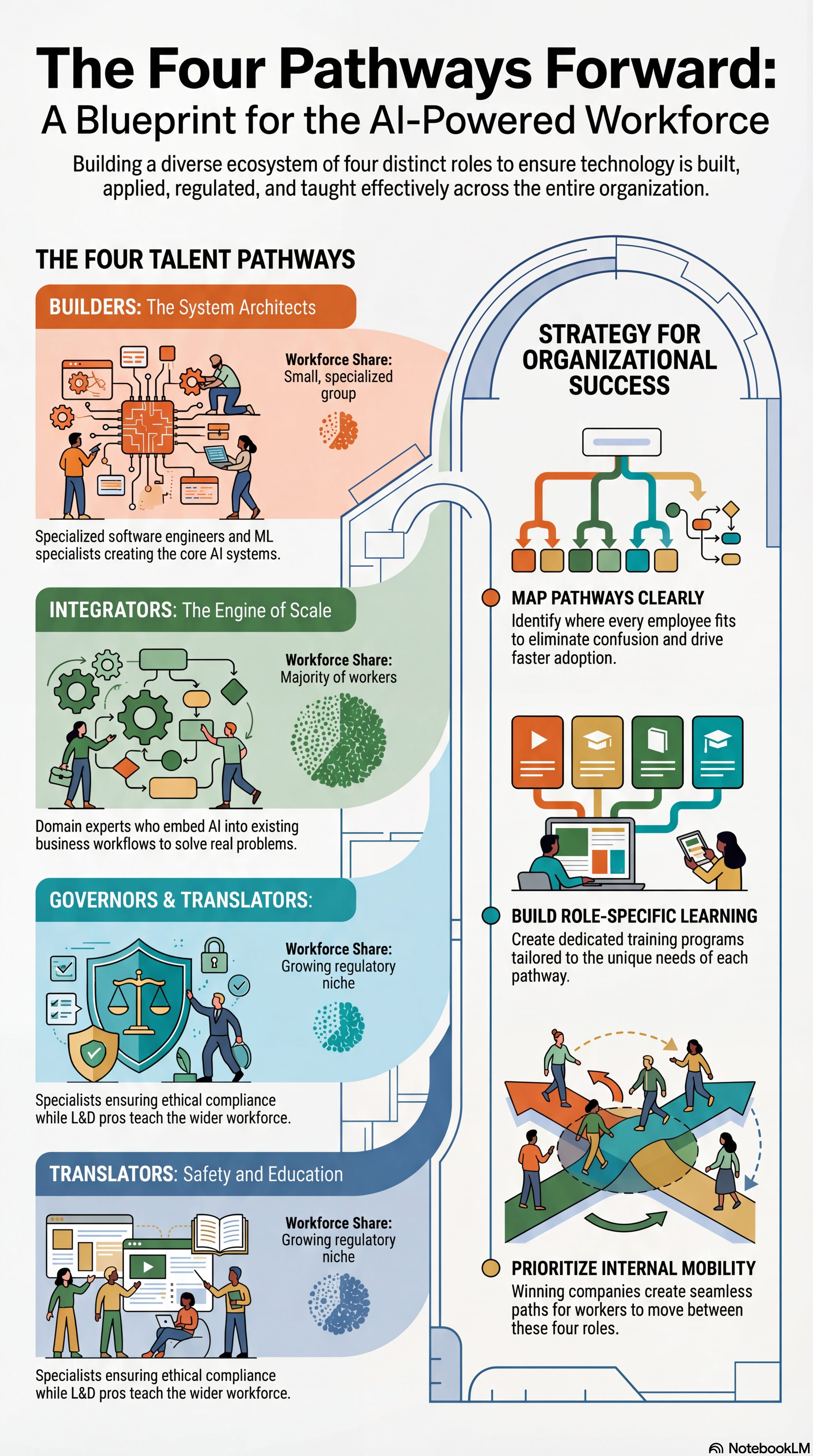
There are at least four distinct pathways for people working alongside AI, and organizations that understand this are building the future faster.
Builders are the software engineers and AI/ML specialists creating the systems. High demand, specialized skills, narrow percentage of the workforce. These roles matter — but they’re not where most people will land.
Integrators are the business analysts, operations managers, and product leads embedding AI into workflows. They have domain expertise. They understand the business. Now they’re learning to apply AI to the problems they already know how to solve. This is where scale happens.
Governors are the compliance officers, ethics specialists, and risk managers ensuring AI is used responsibly. As regulation increases (hello, EU AI Act), this pathway grows. Someone needs to make sure the AI doesn’t create legal, ethical, or reputational disasters.
The future isn’t something that happens to you. It’s something you build — one skill at a time, one pathway at a time, one conversation at a time.
Translators are the L&D professionals, change management specialists, and trainers teaching everyone else. They don’t build the AI. They don’t regulate it. They make sure the other three pathways exist and are accessible.
Most workers will be Integrators. Some will be Translators. A smaller group will be Builders or Governors. The point isn’t that everyone takes the same path — it’s that multiple paths exist.
Companies that map these pathways clearly, build learning programs for each, and create internal mobility between them? Those are the ones that win.
What Managers Can Do Today
You don’t need a billion-dollar budget to start. You need intention, a plan, and follow-through.
Here’s what you can do this week, this month, this quarter:
This week: Have one conversation with each direct report. Ask: Which of these four pathways sounds like you? Where do they want to go? What excites them? What scares them? Don’t assume. Ask.
This month: Identify one AI tool your team should pilot. Not the fanciest one. Not the one everyone’s talking about. The one that solves a real problem your team has today. Set up a learning session. Let people experiment. Create space for failure.
This quarter: Build a prompt library for your team’s most common tasks. Not a top-down mandate — a shared resource. When someone figures out a better way to draft a client email or summarize a dataset, they add it to the library. Make learning visible and shareable.
Map skills to lanes. Look at your team. Who’s a natural Integrator — already thinking about how tools fit into workflows? Who’s a potential Governor — the person who always asks “but should we?” Who’s your Translator — the one who explains complex ideas simply?
Build peer learning. Pair your AI power users with people just getting started. Not formal mentorship programs with paperwork. Just: “Hey, Sarah figured out how to do X in half the time. She’s doing a lunch-and-learn Thursday. You should come.”
Budget for training. Even $500 per person gets you Coursera, LinkedIn Learning, or role-specific certifications. If you’re managing a team, you likely have discretionary budget. Use it.
Celebrate adoption. Recognize people who share what they learn. The person who figured out a better workflow and taught the team? That’s leadership. Make it visible. Make it valued.
The point isn’t perfection. It’s momentum. Start somewhere. Start small. Start tomorrow morning.
If Your Leadership Isn’t Moving Fast Enough (You Can Still Prepare)
Maybe your company hasn’t announced a billion-dollar training program. Maybe your manager hasn’t asked which pathway excites you. Maybe you’re looking around and thinking, No one’s investing in me — what now?
Here’s the truth: You don’t need permission to prepare.
You don’t need a corporate training budget to build capability. You don’t need your manager’s approval to learn something new. You just need curiosity, consistency, and a willingness to experiment.
Self-directed learning works. OpenAI has free tutorials. Google offers AI fundamentals courses. YouTube is full of practical how-to content. You don’t need expensive bootcamps. You need focus and follow-through.
Experiment in your current role. Pick one task you do every week. Try AI on it. Summarizing meeting notes. Drafting first versions of reports. Researching competitive landscape. See what works. See what doesn’t. Learn by doing.
Document what you learn. Keep a “wins log.” What did you try? What worked? What didn’t? What would you do differently next time? Future you (and future employers) will thank you for the clarity.
The point isn’t perfection. It’s momentum.
Build your portfolio. Create examples of AI-assisted work. Show the before and after. Quantify the time saved or quality improved. When you interview for your next role, you’ll have proof — not just claims.
Find your lane. Which of the four pathways fits your strengths? Are you someone who loves learning new tools? (Integrator.) Do you naturally ask ethical questions? (Governor.) Do you explain things well? (Translator.) Knowing where you’re headed makes the learning focused.
Join communities. LinkedIn groups. Local meetups. Online forums where people share AI workflows. Learning alone is hard. Learning with others who are figuring it out too? That’s momentum.
Become the resource. When you figure something out, share it. Write it up. Show a colleague. Become the person others ask for help. That’s how you build visibility and value — even in companies that aren’t formally investing.
Position for mobility. Even if your current employer is slow, you’re building skills that transfer. The next company might be smarter. The next manager might get it. When that opportunity comes, you’ll be ready.
Start small. Build momentum. Document progress. You’re not waiting for someone else to invest in you. You’re investing in yourself.
What Comes Next
The companies investing billions show what’s possible at scale. But you don’t need to be Walmart to make this work.
Managers can start with one conversation, one tool, one learning session.
Individual contributors can start with one free course, one experiment, one task improved.
The future isn’t something that happens to you. It’s something you build — one skill at a time, one pathway at a time, one conversation at a time.
Whether you’re leading a team or building your own capability, the opportunity is real. The pathways exist. The tools are available (many for free). What’s left is action.
Some companies will invest billions. Some will invest hundreds. Some will invest nothing and hope for the best. But you? You get to decide where you land. You get to decide whether you’re prepared. You get to decide whether you’re building the future or waiting for it to happen.
The $2.5 billion bet shows what’s possible when companies choose to invest in people. But the real bet — the one that matters most — is the one you place on yourself.
Limitless Talent is mapping the Talent Intelligence Revolution happening before our eyes.
I’m Robert Merrill, technical recruiter & former developer turned founder & entrepreneur—fascinated with leveraging emerging technologies to boost human talent potential.
I’m curious how companies can build talent strategies that prepare people for AI transformation — not replace them with it. If you’re designing learning pathways, rethinking career architecture, or trying to figure out how your workforce thrives alongside AI, I want to know what you’re doing.
Please share.