


McKinsey published a report titled The economic potential of generative AI and relates several significant areas where Generative AI can be used to greatly boost the economic output of the world.
Artificial Intelligence (AI) has been revolutionizing industries worldwide, and one specific branch called "generative AI" is poised to have a profound impact on the global economy. McKenzie believes generative AI brings enormous value to businesses and retains great potential to reshape the way we work.
Their report lists the following ways Generative AI is set to change the world economy
1. Unleashing Trillions of Dollars in Value:
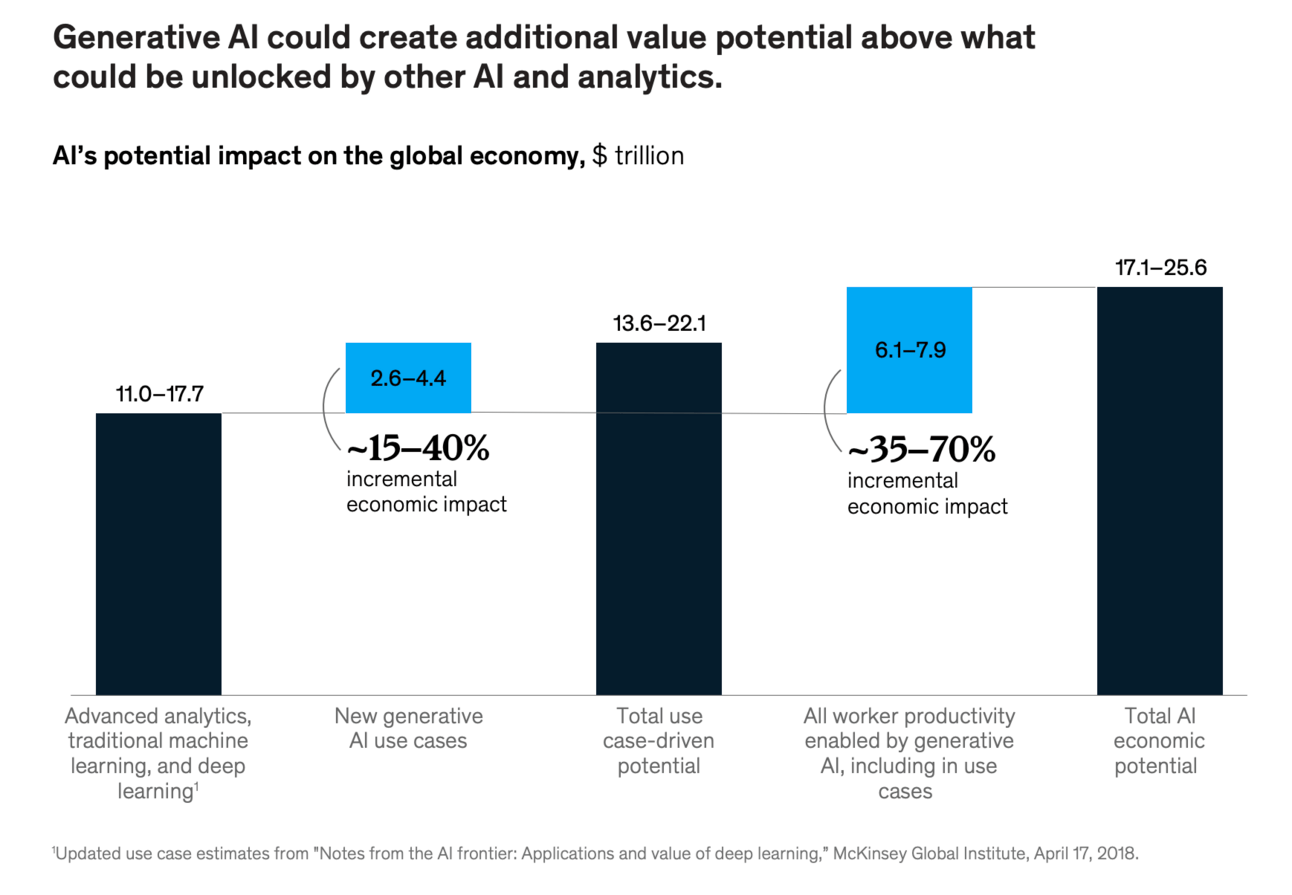
Generative AI has the potential to unlock enormous economic value. Recent research estimates suggest that it could add an astounding $2.6 trillion to $4.4 trillion annually across various use cases. To put this into perspective, this would be equivalent to a 15 to 40 percent increase in the impact of all artificial intelligence combined. This remarkable value highlights the immense potential of generative AI to drive economic growth.
2. Key Areas of Impact:
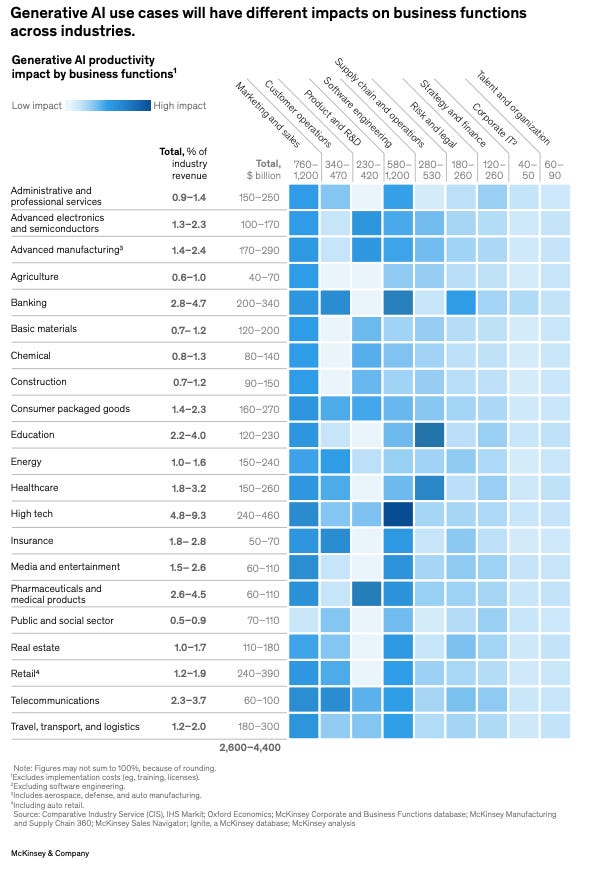
Generative AI's value proposition spans multiple business functions, delivering substantial benefits in customer operations, marketing and sales, software engineering, and R&D. By leveraging generative AI, businesses can improve customer interactions, generate creative marketing content, automate code writing, and tackle numerous other tasks. The technology's versatility makes it an invaluable tool across industries and sectors.
3. Industry-wide Transformation:
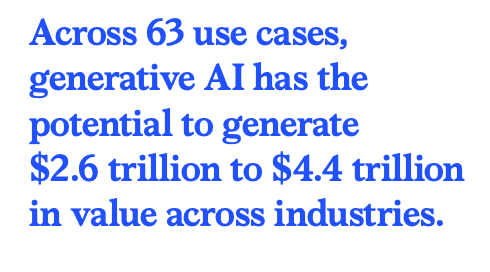
Generative AI is not limited to specific industries; its impact extends across all sectors. Banking, high tech, and life sciences are among the industries projected to experience significant revenue gains from generative AI implementation. For instance, the banking industry could witness an additional value of $200 billion to $340 billion annually, while retail and consumer packaged goods stand to gain $400 billion to $660 billion a year. These figures underscore the transformative potential of generative AI across diverse sectors.Across 63 use cases, generative AI has the potential to generate $2.6 trillion to $4.4 trillion in value across industries.
4. Redefining Work and Enhancing Productivity:
Generative AI has the power to change the way we work. By automating certain tasks, it can augment the capabilities of individual workers, leading to increased productivity. Current estimates suggest that generative AI and other technologies can automate around 60 to 70 percent of employees' time, significantly reducing mundane work. This allows workers to focus on higher-value activities, enabling them to deliver more meaningful contributions to their organizations.
5. Accelerating Workforce Transformation:
With the rapid advancements in generative AI, the pace of workforce transformation is set to accelerate. Previous estimates predicted that half of all work activities could be automated by 2055, but now, experts anticipate this milestone to be reached as early as 2045. This accelerated timeline underscores the potential for generative AI to reshape the future of work.
6. Fostering Economic Growth and Inclusion:
Generative AI, in conjunction with other technologies, can substantially enhance labor productivity, leading to economic growth. It is projected that generative AI alone could contribute an annual labor productivity growth of 0.1 to 0.6 percent through 2040. Furthermore, by combining generative AI with other automation technologies, overall productivity growth could reach 0.2 to 3.3 percentage points per year. To maximize the benefits, it is essential to support workers in acquiring new skills and facilitating smooth job transitions.
Conclusion:
The era of generative AI is dawning upon us, holding immense promise for the global economy. Its potential to add trillions of dollars in value, reshape industries, redefine work, and fuel productivity growth is undeniable. However, while we embark on this transformative journey, it is crucial for business leaders and society to navigate challenges such as risk management, upskilling the workforce, and rethinking core business processes. By addressing these challenges, we can harness the full potential of generative AI and create a more prosperous and inclusive world for all.